All posts by Jenny Henningsen

#66: Pentahexaflexagon Folding Calendar

PENTAHEXAFLEXAGON. Say it 3 times fast! In this mini spark learn about math while doing this “fun” make-it-yourself calendar project. The calendars do require cutting and gluing so they are not truly origami; rather they would be under the category of paper fun.

Spark your thinking!

  1. Set up your Math Mini Spark recording page: #66: Pentahexaflexagon folding calendar
  2. Learn about different types of -flexagons. Record 3 ideas from the teaching page. How do these puzzles connect to mathematics?
  3. Watch this video before printing out the project.  On a scale of 1-5 how hard do you think it will be to create this project? 

4. Open the calendar template and read the instructions on the top. Gather your supplies. 

5. Print the template. If you would like the template in color, as your teacher for help. Rewatch this video as you build.**Note-If you would prefer written instructions with steps, this webpage has them created for you.

6. Share your Math Mini Spark Mini Spark recording page and your finished project. with your teacher or EY Coordinator.

OPTIONAL: If you would like to try folding this project without the calendar dates you can use this template.

Note Lesson adapted from https://make-origami.com/flexagon-calendar/

If this mini spark has not been updated with the current year’s calendar, ask your EY teacher to modify it.


Check out math mini spark #39 for more folding fun

Nebraska Department Water, Energy, & Environment Calendar Contest-Closed for now

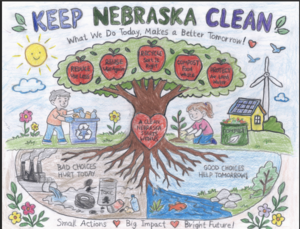
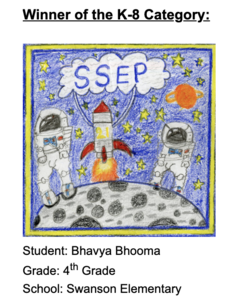
2026 Winner-Bhavya Swanson Elementary


Recycling, composting, and keeping litter in its place are among the many ways we keep Nebraska clean.

The Nebraska Department of Water, Energy, and Environment is inviting students to put their talents to good use by submitting a drawing for the 2027 “Nebraska: Don’t Waste It!” calendar.  We’re looking for drawings that demonstrate the importance of good environmental practices and tips on reducing waste, recycling, and protecting Nebraska’s air, land, and water.

Theme-Create a drawing or painting that shows how we can keep Nebraska clean by recycling, composting, properly disposing of household hazardous waste (like old paint and cleaning products), cleaning up litter, and any other activity that will keep our air, land, and water clean.

Who: Students K-12 in Nebraska

Due Date: May 1, 2027

Artwork Info: Submit all artwork on 8 ½” x 11” unlined white paper in a landscape, or horizontal, orientation.  Please use tape (no staples or glue) to attach the label. Each piece of artwork must have a label! Mail your artwork flat—do not fold. Entries become the property of DWEE and will not be returned. Artwork may be used for promotional purposes. Fill out this Entry Label.pdf  and attach to the back of your artwork.

Media

Markers, watercolors, tempera, oils, crayons, chalk, acrylic, or colored pencils (no pen and ink, please) are accepted.

Main Contest Webpage

Additional Guidelines

2026 Winners

If your artwork is chosen for the calendar, you will:

  • Have your artwork, name and school’s name featured on a page of the calendar;
  • Be invited to an awards presentation at the State Capitol in Lincoln;
  • Receive copies of the calendar to share with family and friends; and
  • Help educate others about how to protect our environment.
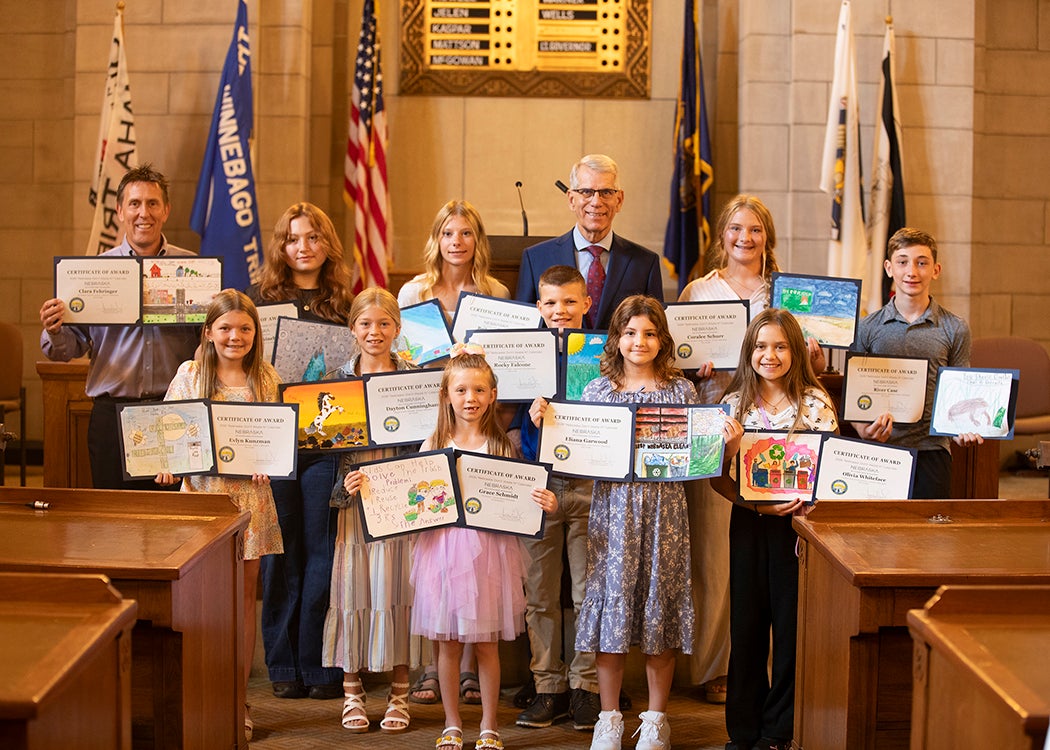
Winners of the 2026 calendar contest were recognized in a ceremony at the Capitol on July 24, 2025.


#18: My Starter Pack

Create a ‘new you’ starter pack to share your goals, interests and areas of growth for the year to come.

  1. Set up your SEL mini spark recording page: #18: My Starter Pack
  2. Download Adobe Express from Mosyle.
  3. In the search bar, type “Starter Pack” to find the template for this project. 
  4. Follow the step-by-step instructions on the right side to customize your project
  5. Once complete, hit the “share activity” button and email link to your EY teacher. Also paste your project onto your mini spark recording page.
  6. Share your SEL mini spark recording page with your teacher or the EY coordinator in your building.

#114: Scientific Calculator Lessons

Spark your thinking!

  1. Set up your Math Mini Spark recording page: #114: Scientific Calculator Lessons
  2. Watch this video. Record 3 new learnings, 2 things you will try, and 1 question you still have. 

  1. Open this teaching page and study it for 5 minutes. Record 5 keys and what they do on your recording page. 
  2. Pretend you are a scientific calculator. Write about one of your keys and how it will help you when doing math. 
  3. Share your Math Mini Spark Mini Spark recording page with your teacher or EY Coordinator.

Mission Patch Design Contest-Send your art to space! Contest Closed


See Bhavya’s art on the News! https://www.wowt.com/2026/03/04/metropolitan-community-college-announces-winners-mission-patch-contest/

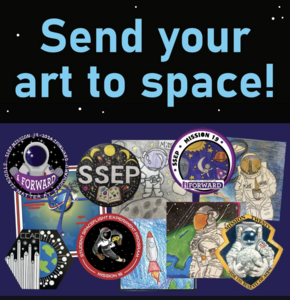
You are invited to design a mission patch that could be flown to the International Space Station (ISS) in summer 2026! Each community participating in SSEP can fly up to two Mission Patches to the International Space Station.

What is a real mission patch?: A NASA mission patch is a special badge that astronauts wear to show their spaceflight mission. These patches have symbols that tell the story of the mission, include the crew’s names, and show important parts like the mission’s goal or where they’re going.

What: On paper, design a 3.5 x 3.5 mission patch for Mission #21

When: Patch designs due Feb. 1, 2026.

Who: K-12 students in Douglas, Sarpy, Dodge and Washington counties, including students taking dual enrollment classes with MCC and MCC students

Details: Through a partnership with the National Center for Earth and Space Science Education, MCC is participating in the Student Spaceflights Experiments Program (SSEP) Mission 21, which will send a microgravity experiment to the ISS. Microgravity sounds very technical but an experiment in microgravity is an experiment in a weightless environment, and in the case of SSEP, the experiment is operated by the astronauts in the weightless environment aboard ISS.
The winning patch design could accompany the MCC student experiment to the ISS.

Examples of patches selected: Visit this website to see a collection of patches that were chosen for mission 17 to the Space Station.

Before you get started: Read more about the project that was chosen for ISS mission 20.

Interested in participating?

Reach out to your EY coordinator to help with submissions.

Teachers and Parents: Patch designs must be accompanied by a completed submission form. For patch design questions and to get more information about submissions, email LaunchToLearn@mccneb.edu


#113: Crayon Math


In this math mini spark you will learn a little about the history of crayon colors, answer some crayon math story problems, and learn more about how crayons are made.

Spark your thinking!

1. Set up your math mini spark recording page: #113: Crayon Math

2. Go to this website and study the graph showing how the the colors of crayons have changed over time. Record 5 observations.

3. Read this paragraph from Bedtime math.  Record the data on your recording page.

We just love this map of Crayola crayon colors over the years. In 1903, there were just 8 crayon colors, but by 1935 it had doubled to 16 colors. The chart creator, Stephen von Worley, uses years with an exact multiple of the original 8 colors, so the stripes line up nicely. 1949 has 48 colors, 6 times as many 8, while 2010 shows about 15 times 8, or 120 colors. Today, Crayola® Crayons are made in 148 unique colors, but don’t stop counting there! Some colors are offered in special effects, further expanding our color selection with specialty crayons like glitter, pearl, confetti, metallic, bold & bright, and more!

4. Answer these questions in your notebook.

a. If a machine makes blue-violet crayons the 1st day, lime green the next day, mac ‘n cheese the next, and then blue-violet again to repeat the pattern, what color does it make on the 20th day?

b. When does it make the 7th batch of blue-violet?

c. The Crayola factory in Easton, PA has a sign on the counter that says how many crayons the factory has made. If the sign said 146,037,500,000 crayons,  what is that number in scientific notation? Ask for help with this if needed.

Scroll to the end of this post to check your work.

5. Watch this video about crayons.  Choose 2 questions to answer on your recording page. Use two sentences for each answer.

  1. Describe the process of how the wax mixture is transformed into crayons.
  2. Mention some of the unique crayon colors that were listed in the video.
  3. How does the video describe the distribution of Crayola crayons to the public?

6. Share your mini spark with your teacher or the EY coordinator in your building.

Lesson adapted from Bedtime Math

Check out the Crayon Project  at the EY website.


a. Lime green, since it’s the 2nd crayon in the new set of 3 starting on 19.

b. On the 19th day, since it will have just finished 6 full batches of the 3 colors.

c. 146,037,500,000 crayons in scientific notation is  1.460375 X 10 ^11


#112: Fermi math warm up

If you have read the book Counting on Frank by Rod Clement then you are aware already of how a vivid imagination can bring to life a wide array of mathematics related to estimation, number, space, measurement, and chance and data ideas. In this math mini spark you will explore the story and work through some challenge problems.

Spark your math thinking!

1. Set up your math mini spark recording page: #112: Fermi math warm up

2. Listen to this story. On your recording page make a list of the 5 examples that are presented in the story. Which of the facts presented in the story do you think would be the hardest to prove. Why?

3.  Look over these questions. For each one, make a list  of the information you would need to find out if you were to figure out the answer.

How many sheets of paper could be stacked from the floor to the ceiling?

How many bricks are on the exterior of a school building?

How many kernels of popcorn would it take to fill your classroom?

4.  Write 5 of your own challenge questions that require estimation to solve.

5. Share your math mini spark recording page with your teacher or EY coordinator.

The type of math you learned about in this mini spark is called Fermi math. Check out the FERMI math badges at the EY website.


#112: Fermi math-warm up


If you have read the book Counting on Frank by Rod Clement then you are aware already of how a vivid imagination can bring to life a wide array of mathematics related to estimation, number, space, measurement, and chance and data ideas. In this math mini spark you will explore the story and work through some challenge problems.

Spark your math thinking!

1. Set up your math mini spark recording page: #112: Fermi math warm up

2. Listen to this story. On your recording page record 10 of the facts that he presents to you.

3.

4.  Open this document or print it if you would like. Complete the math thinking on your recording page or on the document.

5. Share your math mini spark recording page with your teacher or EY coordinator.


The type of math you did in this mini spark is called Fermi math. Check out the FERMI math badges at the EY website.


Name a Snowplow-Contest Closed

This contest is closed but the  winners were announced. They had over 4500 submission from 219 schools. Westside didn’t have any winners this year, but start thinking of creative names for next year! ! For now, check out the winning names for 2025.

We need help naming 16 snowplows in the Nebraska Department of Transportation’s fleet. Now through October 3, students in grades K–6 can submit their most imaginative, silly, or clever names for a chance to see their idea featured on one of NDOT’s 600 snowplows—trackable in real time at 511.nebraska.gov. Two winners will be selected from each of NDOT’s eight Districts. View the district map here.

Contest Details

  • Who can enter: Nebraska students in grades K–6
  • Deadline: Entries due by 11:59 p.m. Friday, October 3
  • Privacy: Student and teacher names will not be shared publicly — only winning plow names and their schools will appear in NDOT promotions.
  • How to submit:

LInk to Contest Information

Reach out to your teacher or EY coordinator if you would like help with your submission.


#40: How Small is an Atom?

You probably already know everything is made up of little tiny things called atoms or even that each atom is made up of even smaller particles called protons, neutrons, and electrons. And you’ve probably heard that atoms are small. But I bet you haven’t ever thought about how small atoms really are.

Spark your thinking!

1. Set up your Science mini spark recording page: #40: How Small is an Atom

2.   Watch this TED-Ed video to learn more about the topic. Record 5 facts from the video.

3.  The Kids Should See this webpage has created a lesson about the world’s smallest movie.  Read this information and write 3-5 details on your recording page.

Magnifying carbon monoxide (CO) atoms to over 100 million times their actual size, arranging them into a series of 242 still images, and then animating them together, scientists at IBM Research have made the smallest movie ever. Wait, how small is that again?

“If an atom was the size of an orange, then the orange would be the size of the whole planet Earth.”

atom
You will watch a a 60-second movie, “with a frame size of only 45 nanometres by 25 nanometres (45 x 25 billionths of a metre)”. It is called A Boy and His Atom. In 2013, it was Guinness World Records-verified to be the smallest stop-motion film in the world:

“Individual molecules of carbon monoxide were “placed” as pixels on a copper sheet to create each frame of the film. The molecules were positioned using a Scanning Tunnelling Microscope (STM), which uses an ultra-fine metal tip to move the molecules with electrical charge… Once the molecules of carbon monoxide were in place in each frame, the STM took 4 min 53 sec to scan the whole frame to build up the image recorded on film. This process was meticulously repeated for each frame.”

4.  Watch the movie, A Boy and His Atom. On your recording page explain what makes this movie so unique.

5. Finish up this mini spark by watching the making of the the world smallest movie video. How did the scientists feel about the project? How did they get the atoms to move?

6. Share your science mini spark recording page with your teacher/EY coordinator.