Category Archives: Learning Opportunities

#43: Exploring Binary Numbers

01001001 00100000 01101100 01101111 01110110 01100101 00100000 01101101 01100001 01110100 01101000 00100000 01101101 01101001 01101110 01101001 00100000 01110011 01110000 01100001 01110010 01101011 01110011

No, I didn’t just type a bunch of random 0’s and 1’s above.  I actually typed a sentence into a binary translator site and had it converted to binary.  Our number system (Base 10), uses 10 digits…0, 1, 2, 3, 4, 5, 6, 7, 8, and 9.  In the binary number system (Base 2), there are only 2 digits…0s and 1s.  It’s a little confusing at first, but once you get the hang of it, it can actually be quite fun!

Spark your math thinking!

  1. Set up your math mini spark recording page: #43: Exploring Binary Numbers
  2. Watch this Binary Number System vide to get started. Take notes along with the teacher. Pause the video as needed.

3. Use the Binary Translator site to figure out what all those 1s and 0s at the top of this post mean.  record the answer on your recording sheet.

4. Then come up with your own sentence to translate to 1s and 0s and put it on your recording sheet.

5. Watch this video where Instagram’s Kevin Systrom explains how binary numbers play into pixels and images.  There’s a LOT of information in this video and it goes fast.  Feel free pause it, re-watch it, etc.

6. There are 10 types of people in this world…those who understand binary and those who don’t. Hopefully after completing this math mini spark you’ll “get” the joke!  🙂

Share your math mini spark recording page with your teacher/EY coordinator.

#42: Multiplying Cheese and Milk

This mini spark is about fractions and multiplying cheese and milk.

Spark your math thinking!

1. Set up your math mini spark recording page: #42: Multiplying Cheese and Milk

2. This is a clip from my absolute favorite Home Improvement episode.  Most of you are probably too young to remember the show, but you can catch re-runs sometimes or find them on You Tube.  This particular episode is related to math and talks about some of the “crazy” rules and words mathematicians use

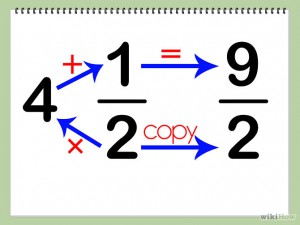
3.  The steps to multiplying fractions can be confusing.  Watch this video as a reminder. Do the math along with the teacher in the video. mult_fractions


4. Figure out the answer to Jill’s “cheese milk” recipe:  1 1/2 lbs of cheese x 1 1/2 gallons of milk. Record the all of the math and the answer.

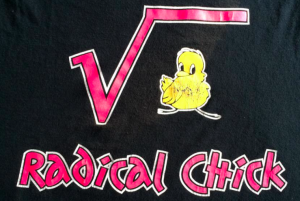
5. There are times when a math item can be called different names.  In the video above, they called mixed numbers, compound fractions. My favorite math word is radical! It can also be called root symbol. I like it so much I had a shirt made! Do a little research and find some math terms that go by more than one name.

Screen Shot 2015-05-21 at 10.23.49 AM

6. Share your math mini spark recording page with your teacher/EY  coordinator.
#41: Future Spacecraft

Will future spacecraft fit in our pockets?  Learn about  this small technology and how scientists are exploring our world.

Spark your math thinking!

  1. Set up your math mini spark recording page: #41: Future Spacecraft
  2. Watch this video, write about some of the calculation scientist must make for these tiny spacecraft to be created. 

3. Think about the following:  NASA provides opportunities for students, researchers and industry to launch their small satellite payloads on NASA’s own launches.  What type of small satellite would you build and what type of data or experiment would you carry out if you could send a small satellite to space?

4. Read about Specific Impulse on this site.  It’s some higher level math, but try to read through it and pick out at least one new thing you can write about on your recording page.

5. Read about SmallSats and CubeSats at NASA. Record some details on your recording sheet.

6. Share your math mini spark recording page with your teacher/EY coordinator.
Wait…is this a Math Spark or a Science Spark?  Math and science are so intertwined that it’s hard to tell sometimes whether you’re doing one or the other.  Many times it’s both!

#20-Babe Ruth

Babe Ruth (1895–1948) is considered one of the greatest baseball players in history. He changed the game by popularizing the mighty home run swing rather than just relying on small, tactical plays. Known as “The Sultan of Swat” and “The Great Bambino,” he hit 714 home runs during his career.

Spark your thinking!

1.  Set up your Social Studies Mini Spark Page: #20: Babe Ruth

2. Read about Babe Ruth at Britannica. Make a mini timeline on your recording page. Include 5 +  dates with details about those dates.

3. Listen to the the Babe and I, a picture book about a family’s experiences during the the great depression. Answer the questions below.


Choose 2 of these questions to answer in 2+ sentences.

What was the economic climate like in America during 1932, and how did it affect the main character’s family?

What unique business arrangement does the boy make with Mrs. Johnson, and why is it mutually beneficial?

How do the boys figure out which newspaper headlines sell the best, and what does this say about human nature?

How does Babe Ruth change the boys’ lives? What did the $5 bill represent to them beyond just money?

3.  David Adler,  the author of The Babe and I,  has written picture books about many famous humans. Look over the different books on this list. Record the names of 3 books that you would be interested in reading.

4. Share your social studies mini spark recording page with your teacher/EY coordinator.

Check out these Social Studies mini sparks about other events during the Great Depression


#26: STEAM Challenge: Straws

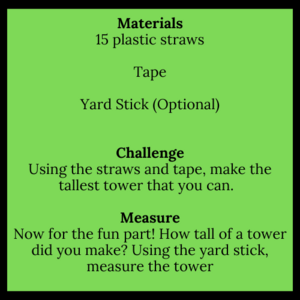
Dive in to this building challenge? Grab some straws and tape and get started! With just these two materials, you can create amazing structures.

Spark your thinking!

1. Set up your STEAM mini spark recording page: #47: STEAM Challenge: Straws

2. Look over the STEAM challenge.

3. Make a sketch of what your structure will look like and any ideas that you have. Add a picture of your sketch to your recording page.

4. Gather the materials you will need. Ask an adult to help you if necessary.

5.  Take a picture of your supplies before you start. Add the picture to your recording sheet.

6. Take a picture of you final project at add it to your recording sheet. Record the height of your project.

7. Explain your project, what you did well on this challenge and where you can improve.

8. Share your STEAM mini spark recording page with your teacher/EY coordinator.

#40: Universal Calendar Puzzle

This is a date calculation puzzle to try! Other date puzzles can be found at Math Mini Spark #30 and #90.

Spark your math thinking!

  1. Set up your math mini spark recording page: #40: Universal Calendar Puzzle
  2.  Take notes as you watch the tutorial. It is also helpful to pause the video while you are watching to do the calculations. NOTE:Pause the video and calculate the date 10.19.1902.  Unpause the video to see if you were correct.

3. This info sheet is very helpful.  Print it to help you do step number 4.

4.Please complete two date calculations of your choice from start to finish and put the date, your math and your solution on your recording page.

5. Share your math mini spark recording page with your teacher/EY coordinator.

#39: Hexaflexagon DIY

Learn how to make a really fun geometric toy—a Hexaflexagon! There are many types of flexagons. The names of flexagons tell the type of polygon and the number of faces.  Hexaflexagons are paper polygons you will create in this math mini spark. They were first discovered in 1939 by Arthur Stone, who set up a Flexagon Committee to investigate their properties.

Spark your math thinking!

  1. Set up your math mini spark recording page: #39: Hexaflexagon DIY
  2. 3 facts to your recording page about these shapes from the intro above.
  3. Watch this Vi Hart video. Add  5 math terms from the video to your note taking page.

4. Watch this video. Record 5 math terms on your recording page.

5. Print and read the instruction page. READ IT A SECOND TIME VERY CAREFULLY BEFORE YOU START. Write “I READ IT TWICE” ON YOUR RECORDING PAGE.

6. Make your project

** Optional-larger template

7. Snap a picture of your finished project and add it to your recording page.

8. Share your math mini spark recording page with your teacher/EY coordinator.

OPTIONAL: Other puzzle options-here is a page with instructions and other templates.

Info from: http://www.auntannie.com/Geometric/HexaHexaFlexagon/

Check out Math Mini Spark #66 for more folding fun!

#33: Word Squares

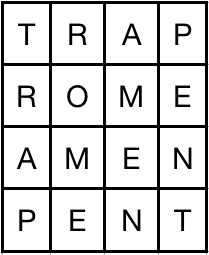
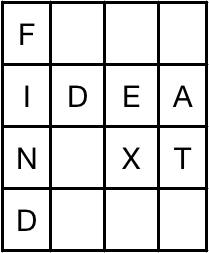
Word squares are grids of letters that cross horizontally and vertically. In the puzzle below, the word TRAP is located in the top row and left-most column; ROME can be seen in the second row from the top and the second column from the left; AMEN is found in the third row from the top and the third column from the left; and PENT occurs in the bottom row and in the right-most column. All the words cross each other in a perfect square arrangement. (taken from Psychology Today)

Spark your thinking!

1. Set up your language arts mini spark recording page:#33:Word Squares

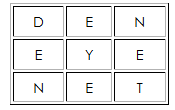
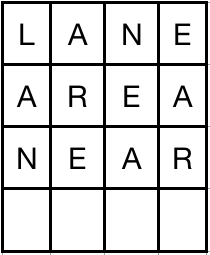
2. Take a look at this one.  DEN is spelled vertically and horizontally in the first column and row respectively.  EYE is spelled vertically and horizontally in the 2nd column/row, and NET is spelled vertically and horizontally in the 3rd column/row


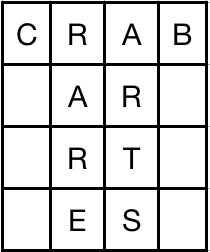
3. Try These 3 Word Squares. Record your answers on your recording page.

4. Create the Word Squares from these given clues!  Use this sheet to record your answers.

5. Share your language arts mini spark recording page and your word square sheet with your teacher/EY coordinator.

24: Skyscraper Puzzles

For this mini spark you will create mini skyscrapers and complete the puzzles following the rules outlined.

Spark your thinking!

1. Set up your STEAM  mini spark recording page: #24: Skyscraper Puzzles 

2. Print out this set of starter puzzles and you will need a set of linking cubes or legos that you can use to build towers.

3. Read these instructions 3 times.

How to Solve a Skyscraper Puzzle:

● Build towers in each of the squares provided sized 1 through 4 tall
● Each row has skyscrapers of different heights (1 through 4), no
duplicate sizes
● Each column has skyscrapers of different heights (1 through 4), no
duplicate sizes
● The rules on the outside (in grey) tell you how many skyscrapers you
can see from that direction or how many skyscrapers you could see while looking down that city block from that spot.
● Taller skyscrapers block your view of shorter ones

4. Watch this teaching video for ideas on how to get started.

5.  Create 16 towers.

6. Solve the 4 X 4 puzzles in your booklet.

7.  When you are done with each puzzle you need to check it.  You can ask a teacher or a friend to do this for you.

1st-Look at each row and column and make sure there are only 1 of each size skyscrapers. 2nd-Look at the numbers in the gray boxes and make sure you can only see the number of skyscrapers when looking “down the street” from each gray box.

8. Make changes if needed and snap a picture of your final project.

9. Share your STEAM mini spark recording page and your completed puzzle pictures with your teacher/EY coordinator.


Check out the Skyscraper Puzzle Badge on the EY Website.

#32: Library Designs

“In a good bookroom you feel in some mysterious way that you are absorbing the wisdom contained in all the books through your skin, without even opening them.”
― Mark Twain

Spark your thinking!

1. Set up your language arts mini spark recording page: #32: Library Designs

2. In early November, 2017, China opened a futuristic library.  Check out this article. What are your opinions about this library? Record 3-5 sentences on your recording sheet.

3. Explore other libraries using this page or do your own research. Write 3-5 sentences about 3 of these beautiful places on your recording sheet.

4. Create design ideas for your own classroom, school, or city library.  What kind of books would you have in your library?  Furniture? Colors? Would there be other things at your library? food? animals? Would your library have only books to check out? Record 10-15 ideas on your recording page.

5. Share your language arts mini spark recording page with your teacher/EY coordinator.