All posts by lspady

#2: Literary Device Lesson: Portmanteau

A portmanteau (pronounced port-MAN-toe) is a type of literary device.  It is a word made by blending at least two words. The new word combines both the sounds and meanings of the originals

Spark your thinking!

1. Set up your language arts mini spark recording page: #2: Literary Device Lesson: Portmanteau

2. A portmanteau is when two words are combined to form a new word which refers to a single concept that retains the meanings of both the original words. Modern language is full of portmanteaus. In fact, the portmanteau is itself a portmanteau. It’s a combination of the French porter (to carry) and manteau (cloak). Record the two parts and meanings of portmanteau on your recording sheet.

3. Write these examples on your recording page.

 smog (smoke + fog) – hazy, polluted air

internet (interconnected + network) – a computer network of information

labradoodle (labrador + poodle) – a hybrid dog breed with parentage from a labrador retriever and a poodle

pluot (plum + apricot) – a hybrid stone fruit that combines the characteristics of a plum and an apricot

4. To form a portmanteau, usually the first segment of one word is attached to the final segment of another word. Some portmanteau words are blended in other ways, like combining the initial segments of both words. Look at the examples that you wrote on your recording sheet or find 3 of your own.  Describe how each of the words were created

Example: spork (spoon + fork) – an eating utensil that serves as both a spoon and a fork

Spork is formed by combing the beginning segment of spoon with the last segment of fork.

5. Try this portmanteau creator. Enter two words that are often found together and look to see the combos that are generated for you. Explore several combos and record your two starting words and the results.

5. Create your own portmanteau. Pick two words that are often used together to describe a single concept. For example lettuce and dressing or amazing and spectacular. See if there’s a way to combine them and create a single word that encompasses the meaning of both. Show all of your work on your recording sheet.

6. Portmanteaus are often mistaken for compound words. On your recording page explain how they are different from compound words. When you are done, scroll to the bottom of this post to see if you had the right idea.

7.  Share your language arts mini spark recording page with your teacher/EY coordinator.

Lesson adapted from https://www.grammarly.com/blog/portmanteaus/


A compound word is created when two or more entire words are joined to create one word with a new meaning. For example:

  • Black + bird = blackbird.
  • Foot + ball = football.
  • High + light = highlight.

A portmanteau, on the other hand, occurs when elements of two or more words are blended to create one word with a combined meaning. For example:

  • Breakfast + lunch = brunch.
  • Information + commercial = infomercial.
  • Motor + pedal = moped.

To further illustrate the difference, note that if we were to form a portmanteau word out of black and bird, we would have blird. Likewise, to make a compound word out of breakfast and lunch, we would create the word breakfastlunch.
Hopscotch Video Game Tutorial

Below is a 10 minute video tutorial on how to build a basic game in Hopscotch. Ignore the introduction as it was created for the Westgate Code Crushers enrichment cluster.  Start with the basic instructions in the video, and then tweak it to make it your own!

Modify the Game:  Instead of falling numbers, try verbs, adjectives, nouns, state capitals, etc.  You can also add a background and a scoring system.

Author Visit

At the beginning of the school year, Westside Middle School students were given the opportunity to be beta readers for a young adult novel.  Author Angela Prusia has always had beta readers for her novels, but this was the first time she asked students to give her feedback.  After the book was released in February, Angela noted:

“I’m so grateful for all the amazing feedback from your students on my book, Cafeteria Food, which I renamed Nameless after several students’ suggestions! Hands down, their feedback was better than what I normally receive from adults.”

This slideshow requires JavaScript.

Fourteen students’ names made it on the acknowledgment page in Angela’s book.  She is excited to offer the students another opportunity to be beta readers for the next two books in this trilogy (another decision she made based on the beta readers’ feedback).

During her visit at Westside Middle School, Angela had the students write several different pieces during a Writer’s Workshop.  Click here to download a compilation of their work.

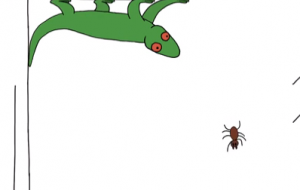
L. Arts Mini-Spark #1: How do geckos defy gravity?

Screen Shot 2015-04-21 at 10.41.16 AM

For this week’s Reading enRichment, complete the following:

  • Read the following writing prompts before you watch the video.
    • What are spatula?  If the spatulae weren’t shaped like spatulas, would it be better for them to be shaped like spheres or cubes? Why?
    • Explain the process that makes the geckos feet “stick” to surfaces.
    • Talk about how the geckos sticky feet can help humans create new materials. How could this help humankind?
  • Watch this TED Talk:  https://youtu.be/YeSuQm7KfaE
  • Pause the video if you need to take notes.  You may need to watch the video more than once.
  • Choose one of the prompts listed above and leave a comment (at least 3-4 sentences).  When leaving a comment, use your first name, grade, and school (i.e. Tyler, 5, Sunset).  Do not publish your email.

NOTE:  There is a section in the video about electrons and charges.  You do not need to understand this 100%, just watch and listen to the narrator explain the process.

Take it a step further by learning more about our world using research and Geckos!

  • Watch this video: https://youtu.be/TlyvS1ckDZM
  • Expand on what you have learned by researching your own animal and responding to this prompt:
    • What is another animal that exhibits an incredible phenomenon, and how can it be used to make life better for humankind?
  • Record your responses on this form

And if you still can’t get enough…This “Prototype This” episode @ https://youtu.be/0yp9tsthL8s is about creating a Gecko Superhero Suit.  Respond to this post after watching the video with any new learnings, thoughts, and/or opinions.

Welcome To Early Enrichment!

These posts are intended for our early learners in the primary grades (K-3), however older students might find the topics interesting and are welcome to participate.  Each week, we will post a learning opportunity (video, app on the iPad, article, writing prompt, etc.) for students to complete individually or in a small group setting.  Students may choose to do any/all of the activities listed.

Week of April 20th Learning Opportunity

BrainPop Jr. Movie of the Week is a free app on the iPad.  This week’s movie is perfect for Earth Day-Reduce, Reuse, Recycle.

Did you learn something new?  Leave a comment and let us know!  When leaving a comment, use your first name only.  If you make a poster, give it to your teacher and have him/her give it to the EY Coordinator at your building.  We may post your picture on our Student Showcase Wiki!

EY Parent Meetings

Thank you to those of you who have submitted questions regarding the EY identification process.  The Google form is still available and we encourage you to enter your questions so we can prepare for the upcoming parent meetings.

reminder_handDon’t Forget!  We’d also like to have your input regarding your child’s strengths.  What you observe at home and outside of the school walls is equally as important as what goes on in school.   Please visit the following link to fill out a parent survey online: http://tinyurl.com/SIGSparent

Parent Meeting Dates

Tuesday, April 21 at Oakdale (6:30 pm in the library): This meeting is intended for parents of students at Paddock Road, Oakdale, Prairie Lane, and Rockbrook

Tuesday, April 28 at Swanson (6:30 pm in the library):  This meeting is intended for parents of students at Hillside, Westbrook, and Swanson

Thursday, April 30 at Sunset Hills (6:30 pm in the library):  This meeting is intended for parents of students at Loveland, Sunset Hills, and Westgate

Sumdog Math Contest

Screen Shot 2015-04-08 at 8.29.40 AM

Check out the free Sumdog math contest!

Sumdog’s math questions are free to use, without any time limit. They include word problems, and cover a broad range of topics.

It will only take an hour or so to get a decent score, and as students play online, they can compete in school or at home.

In order to join in the fun, teachers can enter their class here:
http://www.sumdog.com/enter_contest


Westside Community Schools does not sponsor or endorse the organization or activity described here.

EY Identification Questions

Thank you for using the Google form to submit questions about the EY identification process.  We are trying to be as transparent as possible and appreciate any questions you have.

Q. Under Tier 1, what does E/I time mean?

A. E/I stands for Enrichment/Intervention time (also referred to as I/E time).  It is a 43 minute block of time each day in the schedule for students in grades 3-6.  The EY team has tried to capitalize on the E/I block this year by providing a variety of resources.  We started the year by coming into all classrooms once every 6 days to explain our blog, Symbaloo, seminars, and various other opportunities.  We have also consistently communicated with classroom teachers about possible E/I activities/projects.  Check out some of the results from E/I time on our Student Showcase Wiki.

Q.  When does the next testing occur to move up a Tier?

A. Students take the SAT 10 and OLSAT in 3rd and 5th grade.  In the past, these two grades have been the typical time for a student to qualify for EY.  That being said, we are having discussions about how we can make the ID process ongoing based on a student’s need.  We are also exploring ways we can provide more enrichment opportunities for the primary grades.

Q. Is testing ever based on age instead of grade?

A. The SAGES (Screening Assessment for Gifted Elementary Students) is scored using a normal normative sample, which is stratified on the basis of age (as well as gender, race, ethnic group membership, and geographic location).

Q. These tests are one snap-shot of my child’s ability.  What if the child does not feel well the day of testing?  What else is taken into consideration?

A.  Instead of using a single piece of data or a specific cut-off score to determine a child’s ability, we want to paint a more complete picture of a child’s strength(s) by using various sources of data.  This includes input from the parents and classroom teacher.  Many times, the classroom teacher can speak to the individual scores and tell whether or not they are indicative of the child’s performance in the classroom.

Q. Are Tier 1 services different than services provided to all students? If so, how?

A. Tier 1 services are open to all students, however, we hope to use a child’s participation in Tier 1 opportunities as a way to discuss and modify services needed.  For example, a student receiving Tier 1 services might complete Math Minutes on a weekly basis.  This tells us that the student has an interest in math and might benefit from some of the services we provide in Tier 2.

3D Moving Background in Hopscotch


Several students are “playing” and “branching” projects in Hopscotch, but we’re more interested in the “creating” part!  We know you have great ideas and we want to showcase your amazing creative talent!  We’ve shared a few projects on our wiki, but we want MORE!

Here is a new video tutorial on how to create 3D Moving Backgrounds for video games and other projects in Hopscotch.  Don’t forget all the other great tutorials too!

Paddleball – Instructions start at 28.30


If you create a project in Hopscotch, leave a comment with your name, school, and a description of what you created.  Someone will come to your school and video/take pictures of your amazing work!
Go Code and Create!