All posts by lspady
Origami by Children (OBC)- Closed for now
Calling All Origamists!
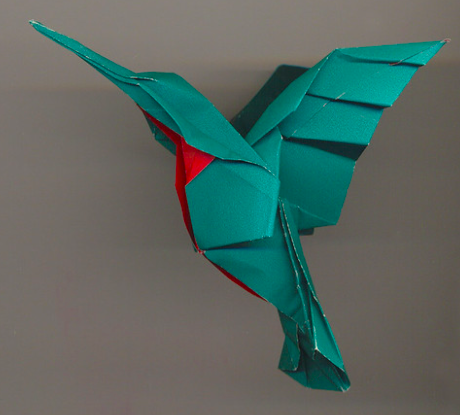
Origami by Children (OBC) is an annual exhibition of outstanding origami by children from around the world. It is a wonderful opportunity for young folders to share their work!
Find out more here: https://origamiusa.org/obc
Contest Dates: TBD
Ages: k-12
Entris Due-Jan 31
Tips for your submission-https://origamiusa.org/obc-tips
The SciFest Essay Contest- Topic AI Closed for now
WHO: 4th – 12th graders
Type of Contest: Essay
Question Prompt: Artificial Intelligence is changing the way people learn, work, and solve problems. From science and medicine to transportation, education, art, and the environment, AI has the potential to shape the future in powerful ways. If you could use artificial intelligence to help the world, what would you use it for and why?
WHEN: TBD
Information
- All entrants must live in the state of Nebraska and be enrolled full-time in a public, private or home school
- Students must be no older than 19 years of age
- Each student may only submit one essay. However, a teacher/coach may submit multiple essays
- Do not exceed 1,000 words (150 words minimum)
Visit https://www.nescifest.com/participate/essay/ for more details.
24th Annual “Why I Want to Go to College” Writing Sweepstakes Closed
The Omaha Storm Chasers are partnering with Nebraska State Treasurer Joey Spellerberg, for the “Why I Want to Go to College” writing sweepstakes. Entries must be postmarked by March 16, 2026.
- Students in grades 7 and 8 are asked to reflect on the value of education and what they hope to achieve through education after high school.
- “This contest gives students a chance to reflect on their educational goals – their life goals – and how to achieve them,” Treasurer Spellerberg said.
- Essays should be limited to 750 words
- Three winners will be chosen from each of Nebraska’s three Congressional districts, and three winners will be chosen from outside Nebraska.
- Winners will receive contributions to the Nebraska Educational Savings Trust (NEST 529) college savings accounts – including $2,000 for first place, $1,000 for second place, and $500 for third place. NEST 529 is the state-sponsored college savings program that allows for tax-advantaged investments and tax-free qualified withdrawals.
- Each Nebraska winner will receive four tickets to the May 3, 2026, Storm Chasers game at Werner Park in Papillion. During the game, winners will be recognized during a brief ceremony prior to the first pitch.
- Entries should be sent with a cover sheet to Alexis Smith, Omaha Storm Chasers, 12356 Ballpark Way, Papillion, NE 68046.
Reach out to the EY coordinator if you need help with editing or submissions.
Cover Sheet
Rules and Additional Details
2025-26 Virginia Frank Memorial Writing Contest-Event Closed

Website: https://omahalibrary.org/virginia-frank-memorial-writing-contest/
Create your own original fiction featuring a character from a book you read on your own.
Deadline: The deadline for 2026 entries is February 20, 2026.
- 750 words or less
- enter online or through the mail (information on the website)
- one entry per contestant
Check out the website for more details and read the winning entries from last year’s contest.
The Friends of Omaha Public Library are currently accepting submissions for the Virginia Frank Memorial Writing Contest. The contest is for students in 5-8th grade. First prize in each grade is $100.
Here is a link to the contest https://omahalibrary
The Virginia Frank Memorial Writing contest is held each year in the spring to recognize the creative writing talent of area students. This contest, sponsored by the Friends of Omaha Public Library, recognizes the top three winners from each grade. Each winner receives a cash prize and certificate, is recognized in a ceremony at the library, and has their story published on the library website. The school libraries of each winning student are also recognized with a matching cash prize.
Eligibility Requirements
-
- Stories must be submitted with an entry form to be considered. Complete all fields either online or on a printed entry form and submit with your story.
- Students must be in 5th to 8th grade and live in Douglas or Sarpy counties.
- Students may be enrolled in public, private, parochial or home school.
- Stories must be typed and no longer than 750 words.
- Entries must be original fiction featuring a character from a book you have enjoyed and read on your own. Identify the book and author from which your character originated in the title or subtitle of your story.
- Only one entry per contestant will be accepted.
- The decision of the judges is final.
- All entries become the property of Friends of Omaha Public Library (FOPL) and may be featured by Omaha Public Library on its website or social media.
- Deadline for entries is February 28, 2020.
Prizes
- First ($100), second ($75) and third place ($50)
- Prizes will be awarded to the top three winners from each grade.
- The school library of the winning students will be recognized with matching cash prizes.
About Virginia Frank
The Virginia Frank Memorial Writing Contest began in 2003 and is named in honor of a longtime Friends of Omaha Public Library volunteer. Virginia Frank was a Central High and UNO graduate. She acquired a master’s degree from Brown University and taught English literature and creative writing at UNO for many years. Her passion for students and young people inspired everyone around her, and her enthusiasm encouraged many students to explore their creative writing talents. Frank volunteered thousands of hours with the Friends of OPL to help ensuring a bright future for our public libraries.
#51 Teeny Tiny Drawing Challenge

One day an illustrator ask herself… just how small can I draw? Today is the day we all find out!
Spark your thinking!
1. Set up your STEAM mini spark page #51 Teeny Tiny Drawing
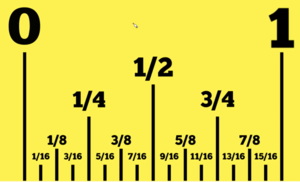
2. Watch this video to remind you how to measure to the nearest 1/32 of and inch. If you had a ruler that had measurements marked to 1/32, how many little lines will there be from 0 to 1. If you do not have a 1/32 ruler, how can you find 1/32?
NOTE: The image of a ruler is at the end of this post if you need it later.
3. Copy this table on to your recording page.
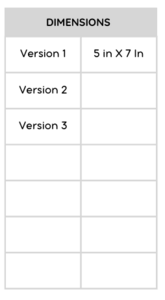
4. Watch this video stop at 2:23. Record any measurements that she makes in your chart.
5. Before you resume the video, predict how many versions of her drawing she can create. Record that number on your recording page.
6. Keep watching the video and recording the measurements in your chart. You will have to pause the video to and zoom in to look closely at the ruler and decide the measurements. The ruler she is using in the video is a 1/32 ruler. (The last drawing was very small to so it is ok if your answer for that one is a little off.
7. Answer these questions.
Which version of the drawing was your favorite and why?
Were the drawing proportional to one another? Explain.
Why was the last drawing so hard to measure.
What are the measurements for her next two drawing if she had increased the paper size instead of decreased. Start with 5 in. X 7in.
8. Share your STEAM mini spark recording page with your teacher/EY coordinator.
OPTIONAL: Create your own series of drawings matching the paper sizes from this challenge.
- Get two pieces of paper, a pencil, and a ruler.
- Use a ruler to carefully measure and draw each rectangle before you start.
- Label each rectangle with its size (length × width).
- Notice how each one gets smaller and smaller — teeny tiny!
| Rectangle | Size (inches) | Space to Draw |
|---|---|---|
| 1️⃣ | 5 in × 7 in | ⬜ Large rectangle space |
| 2️⃣ | 2½ in × 3½ in | ⬜ Medium rectangle space |
| 3️⃣ | 1¼ in × 1¾ in | ⬜ Small rectangle space |
| 4️⃣ | ½ in × ¾ in | ⬜ Tiny rectangle space |
| 5️⃣ | ¼ in × ⅜ in | ⬜ Very tiny rectangle space |
| 6️⃣ | 3/32 in × 4/32 in | ⬜ Teeny-tiniest rectangle space! |
Share your work with your teacher or EY coordinator and get credit for a Second STEAM Mini Spark!
Opera OMAHA: Poetry & Music Project 25/26 Call for Submissions


Students in grades K-12 from Nebraska and Iowa are invited to submit works of poetry on the theme of Memory. Selected poems will be set to music and premiered during a public concert in May, 2026.
Now Accepting Poems for the 25/26 Project-Submission Deadline: November 30, 2025
Submission Guidelines
- Open to all K-12 Students in Nebraska and Iowa
- Students may only submit one (1) poem
- All work must be original
- Poems should be in Google Doc or Word file format
- Poems should be in Times New Roman, Helvetica, or Arial font
- Poems may be in any structure, but may not be more than 150 words long
- Poems should not be more than 1 page in length
- Poems submissions should not include images
- Poems can be submitted via the online submission form
- Poem Submission Deadline: November 30, 2025
Submission Instructions
Poems may be submitted via the online form
25/26 Writing Prompts
The following prompts will help you explore and share your memories and hopefully inspire you to write something that a composer can bring to life.
Memory Museum
Memories so delightful you wish you could hang them in a “you” museum!
Listen: Stephanie Pacheco’s “Where I’m From”
Read: Nikki Giovanni’s “My First Memory (of Librarians”)
Make a quick list of 10 of your favorite things. Like Stephanie, you might remember a beloved field trip. Like Nikki, you might think about how much you love your neighborhood library.
Reread your list, item by item, and pause when one of the beloved items makes you feel something – a jolt of joy, warmth, or hope. Choose the item you’re most excited about and write a poem that tells your reader about the first time you experienced that item: the first time you ate a twist cone at Zesto’s, the first time you remember making your mom laugh so hard she snorted, the first time you realized how far you could kick a soccer ball.
Level up! Be sure to use your five senses (sight, taste, touch, sound, smell) to make that first-time-feeling come alive for your reader!
Memory Interrupted
Exploring what happens to our memories when they work differently than our friends’ memories, don’t work as well as they once did, or get stuck playing on loop.
Listen: a poet from Lincoln East High School (7:48)
Read: Michael Kleber-Diggs’s “It’s a Pagoda Dogwood”
Our memories sometimes work differently than we expect them to. Our brains might hold onto a small, insignificant detail (the name of our childhood friend’s cat) we wish we could download and replace with something more helpful (a math equation we really need to memorize for an upcoming quiz).
Experiences like being autistic, sustaining brain damage, chronic stress, or having anxiety, depression, or OCD can impact our memory function, too. However your memory works is beautiful, dynamic, and unique – something to acknowledge, honor, and celebrate!
Like the poet from Lincoln East High School, you might want to write about the rhythm of your memory, how it gets stuck on a certain idea (like how tasty spaghetti sounds for dinner) and loops and loops and loops. Like Michael Kleber-Diggs, you might think you should be able to remember things you just can’t (like the name of that one park, or song, or the kind of car your best friend always picks you up in.)
Write about a memory that keeps slipping through your fingers, or write about a memory that keeps getting stuck in the folds of your brain.
Level up! Be sure to use your five senses (sight, taste, touch, sound, smell) to make sure your reader can share this memory, too!
Memory Speak
Memories have their own language, their own way of communicating with us, and often take us by surprise.
Listen: a duet from Team Urban Word NYC
Read: Gary Soto’s “Earth Day on the Bay”
Have you ever accidentally kicked an empty can of Diet Coke down the sidewalk and wondered about the person who drank it? Have you ever experienced a memory in a language other than English? Memories come to us in different “languages,” sometimes literally (like the teen poets from Team Urban Word NYC) or figuratively (like the sneaker in Gary’s poem).
Write about a memory that connects you to someone else. Think about things we inherit, like your grandfather’s watch, or your sister’s crooked teeth, or the stranger who signed in ahead of you at the doctor’s office and held the same pen you’re now using to write your name. How does memory keep us connected to each other? To our neighborhood? To our world? If you’re a multilingual writer, you may write this poem – or parts of it – in your home language.
Level up! Be sure to use your five senses (sight, taste, touch, sound, smell) to make sure your reader tastes the sour cherry slushie you’re telling us about or sees the gumball pink sunset you’re watching!
Memory Collector
Some people collect stamps, rubber bands, or dinosaur bones, but you collect memories!
Listen: Harrison Boe’s “Becoming Strangers”
Read: Joy Harjo’s “Memory Sack”
Sometimes we don’t realize something important to us is about to become a memory – the last time we see a friend on the playground before they change schools, the last time our babysitter comes over because we’re now old enough to stay home alone.
You are a Memory Collector – write about the last memory you have of the popsicle before it fell to the hot July sidewalk and became a puddle. Or the last song on the new album before you realized it was over. Or the last chapter of the book you couldn’t put down and didn’t know was already reaching its conclusion.
Like Joy, gather these memories and put them in your Memory Sack. In 150 years, an archaeologist will stumble upon the sack, brimming with your experiences. Where will they put them? What will the news stories say about their discovery? What will your great-great grandchildren learn from them?
Level up! Like a scientist, be sure to use your senses (sight, touch, sound, smell) to make sure your reader understands the importance of this discovery!
Please reach out to the EY coordinator in your building to help you with your poem and submission.
Central Honors Institute Camp 2026

The Central Honors Institute (CHI) is a five-day residential academic camp for middle school students who have completed the 6th or 7th grade and who have demonstrated academic accomplishments, leadership and maturity among their peers.
Join our mailing list for CHI Camp 2026:
Students attend classes during the day (see below) and socialize with peers in the evenings while experiencing life on a community college campus.
- CHI Stream Team: During this biology based track, Stream Team campers will investigate living and non-living objects, food web, and biodiversity in a nearby aquatic ecosystem.
- FLY CHI Track: This track will focus on the fascinating aspect of flight from archery to ornithology, rockets, gliders, combustion and beyond!
- CSI at CHI Track: Campers in this track will investigate and solve a number of puzzling cases throughout the week.
- CHI Creativity Track: Campers will explore their creative potential through teamwork and cooperation.
To learn more, visit: https://www.cccneb.edu/chi/
Do Space

Youth programs at Do Space feature projects involving hardware, software, critical thinking and life skills that promote technology and digital literacy in members aged preschool through age 18.
Check out the events
DO SPACE calendar of events
#85: Compare and Contrast
 Looking at how things are alike and different helps us think critically. It allows us to analyze information about animal behavior and ecology, so we can understand and form our own ideas about how animals live and interact with their environment.
Spark your thinking!
1. Set up your language arts mini spark page #85: Compare and Contrast
2. Read this article about seals and sea lions. Write down 5 details about each animal.
3. This article outlines how the animals are different, but there are ideas in the article that suggest how they are the same as well. On your recording sheet use what you learned to make 4 sentences about seals and sea lions using these sentence starters.
1. __________ and __________ are alike because __________.
2. __________ and __________ are different because __________.
3. The most interesting difference between __________ and __________ is __________.
4. While __________ and __________ are alike because __________, they have different __________.
5. Read this article about crocodiles and alligators. Make a colorful fact sheet with 3 facts for alligators and 3 facts for crocodiles.
6. Create a Venn Diagram on your recording page. Record at least 5 items in each section. The far left section will have information that is only true for alligators, the far right section is only true for crocodiles, and the middle section is information that they share.

7. Share your language arts mini spark page with your teacher/EY coordinator.