Category Archives: Learning Opportunities

#25: Winter Solstice


What is the Winter Solstice? According to Dictionary.com the Winter Solstice lasts for just one moment. It occurs exactly when the Earth’s axial tilt is farthest away from the sun. This usually happens around December 21 or 22 in the Northern Hemisphere or June 20 or 21 in the Southern Hemisphere.

Spark your thinking!

1. Set up your social studies mini spark recording page: #25: Winter Solstice

2. Read these 3 paragraphs. Write a  5 question quiz after reading.  Include multiple choice , true and false, and short answer questions. Make an answer key as well.

If you’re in the Northern Hemisphere, during the solstice the sun will be at its southernmost point in the sky. The higher in latitude you are, the more you’ll notice that the solstice has the shortest day and longest night of the year.

In ancient cultures around the globe, the winter solstice was marked with ceremonies and celebrations. For example, in the days of the Inca Empire the winter solstice was honored with Inti Raymi, or Festival of the Sun. It involved a ceremony in which an Inca priest would “tie” the sun to a column stone in a symbolic effort to keep it from escaping.

Halfway around the world, indigenous people in Finland, Sweden, and Norway participated in the Beiwe Festival. On the winter solstice, worshippers honored the goddess Beiwe by sacrificing white female animals and covering their doorposts with butter for Beiwe to eat on her travels.

3. Watch this video and choose 5 of the questions to answer thoughtfully. Remind your teacher that that answers can be found in the social studies mini spark folder.

1. Describe what would happen to our planet if it did not tilt as it revolves around the Sun.

2. Explain how the tilt of the Earth affects the length of days in the northern and southern hemispheres during winter.

3. What are solstices, and how do they mark the change in seasons?

4. Discuss how civilizations in history, like the Babylonians and Maya, recognized the patterns of Earth’s movement around the Sun.

5. How does the experience of seasons differ for someone living near the equator compared to someone living near the poles?

6. Why might the changing lengths of days and nights be considered important by ancient civilizations?

7. In your opinion, why is it essential for us to understand the relationship between the Earth and the Sun?

8. Describe how the Earth’s movement around the Sun can provide reassurance during the coldest nights of winter.

4. Share your social studies mini spark recording page with your teacher/EY coordinator.

#14: Alpha Bravo Charlie

Say what?

A student recently asked me if I knew the NATO alphabet.  I hadn’t heard of it so I told him to send me an email about it and voila…We have a new Social Studies Mini Spark!

Spark your math thinking!

  1. Set up your social studies mini spark recording page: #14: Alpha Bravo Charlie
  2. Read about the NATO phonetic alphabet by visiting this site.  Record what you have learned.
  3. Learn about how the alphabet was chosen write about some new information that you learned.
  4. Watch this video and then record the spelling of your first name using the correct NATO alphabet words.

5. Check out how the U.S. Navy uses alphabet flags, numeral pennants, numeral flags, and special flags and pennants for visual signaling.  Even though the flags are not used for spelling out words, draw the flags that would spell your first name.

6. Share your social studies mini spark recording page with your teacher/EY coordinator.

CM (Charlie Mike): Means continue mission.  Keep moving forward.  

#24: Dry Tortugas National Park

Almost 70 miles west of Key West lies Dry Tortugas National Park. This 100-square mile park is mostly open water with seven small islands.  You can only get there by boat or seaplane! The park is known all over the world as the home of magnificent Fort Jefferson, beautiful blue waters, lots of coral reefs and marine life, and the tons of bird life that visit the area!

Spark your thinking!

1. Set up your Social Studies  mini spark recording page #24: Dry Tortugas National Park

2. Read this information page about Dry Tortugas National Park. Record several details about the park on your recording sheet.

3.  Watch this video and respond to these questions:  Describe the design features of Fort Jefferson that make it unique compared to other forts? What types of wildlife can be found in the Dry Tortugas, specifically on Hospital Key?
Why is Loggerhead Key important for turtle nesting, and what historical events took place there


4. There are around 300 shipwrecks in this area. Read this teaching page about the Windjammer Wreck. Take number notes while reading. Reminder: Number notes are recording all of the number facts/details that you come across in an article.

5. Share your social studies mini spark recording page with your teacher/EY coordinator.


#30: Make Slime

 Slime is a fun way to study science. Check out this mini spark to learn about the science behind slime. Then check out the Slime Science badge to make your own slime.
Spark your thinking!

1. Set up your STEAM mini spark recording page: #30: Make Slime

2. Watch this video about making slime.  Take notes on your recording sheet while you watch.

3. Using the information from the video, create a quiz for other kids to play. You can use kahoot or google slides. Include at least 10 questions and include the answers as well.

4. Share your STEAM mini spark recording page and your slime quiz with your teacher/EY coordinator.

Make slime using the Slime Science Badge at the EY Website.

#29: Bitsbox 1-Get Started

In this STEAM mini spark you will learn how to sign in to Bitsbox and how to code your own app, food fight.

Spark your thinking!

1. Set up your STEAM mini spark recording page:#29: Bitsbox 1-Get Started

2. Watch this intro video.   Write the first line of code that you will type when creating the app food fight.

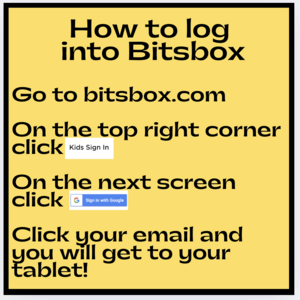
3. Copy these instructions on your recording sheet.

4. Click this link to get to bitsbox or go to www.bitsbox.com and follow the instructions from step 3 to get logged in.

5.  Click on the food fight icon and follow the written instructions step-by-step to code the whole app. Take a screenshot of your app and add it to your recording page.

6. Now, modify  your app it with your own stamp, text, and colors.

7. Take a picture of your new app and add it to your recording sheet.

8. Share your STEAM mini spark recording page with your teacher/EY coordinator.

Check out the bitsbox badge on the EY website.

#29: Bitsbox 2-Code an App

In this STEAM mini spark you will watch how to code an app at Bitsbox and code your own apps. You will learn about the text and stamp commands and as how to work with coordinates.

Spark your thinking!

1. Set up your STEAM mini spark recording page:#29: Bitsbox 2-Code an App

2. Watch this intro video.  On your recording page, record 5 coding terms from the video.

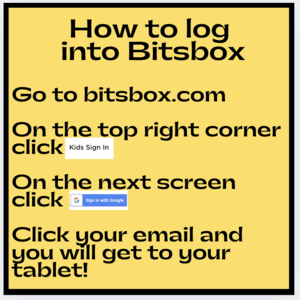
3. Click this link to get to bitsbox or go to bitsbox.com. Click kids sign in on the top right, then click the sign in with google button to get to your tablet.

4. Click this link to get to a few free coding projects provided by Bitsbox. If you would like, you can print them out.

5. Click the new app button. and then add in the 4 digit code on the coding card.

6. Code 1 or 2 of the projects. Take a screenshot of your code and add it to your recording page.

7. Share your STEAM mini spark recording page with your teacher/EY coordinator.

Check out the Bitsbox badges at the EY website.

#28: Rocket Launcher

National STEAM day is celebrated on November 8, but you can create STEAM all year long! Check out this rocket launcher experiment that you can do to celebrate the national day dedicated to Science, Technology, Engineering, Art, and Math.
Spark your thinking!

1. Set up your STEAM mini spark recording page: #28: Rocket Launcher

2. Watch this video. Write down the materials you will need on your recording page

3. Collect the materials you need. Contact the EY coordinator in your building via email if you need help with this step. Add a picture of of your supplies to your recording page.

4. Go back to step 2 and rewatch this video while you are working.

4. Take pictures from your experiment and add them to your recording page.

5. Take a video of your rocket launcher.

6. On your recording page, create a one paragraph summary about your project.

7. Share your STEAM mini spark recording page and your video with your teacher/EY coordinator.

Check out the DIY superstar badge on the EY website

Post adapted from https://projectmc2.mgae.com/#/experiments

#37: Create Your Own National Day

Everyday can be a celebration. Did you know that November 3rd is national sandwich day, December 7th is national letter writing day and January  7th is national bobblehead day?

Spark your thinking!

1. Set up your language arts mini spark recording page: #37: Create Your Own National Day

2. Look over this teaching page. On your recording sheet, write about each of the highlighted days, the history, and how it is celebrated.

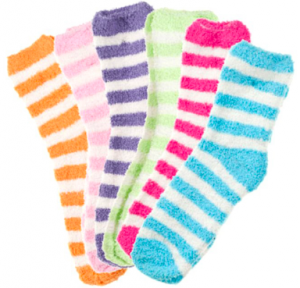
3. What day do feel deserves to add to the list of national celebrations? Pickle day?  It’s observed on November 15. How about National fuzzy sock day? Wear your cozy socks and keep your feet toasty warm all day long. People celebrate this day on December 21st!  Look over this national day list and find 5 more funny days that are national days.


4. What would be a day that you would LOVE to celebrate? Start brainstorming to think of a special day that you would like added to the calendar that is not already observed. Make a list of 5-10 days.

5. Choose your very favorite day from the list you created. Create a colorful information page about your day. Include this information:

The name of your day

3-5 facts about your topic

How can people celebrate this day?

Add color and illustrations to your project.

6. Read about the process of how to formally submit your national day idea to be selected as a “National Day of Celebration”. What information is most important to know about the process.

7. Share your language arts mini spark recording page and project with your teacher/EY coordinator.

#38: Celebration Days

Everyday can be a celebration. Did you know that November 3rd is national sandwich day, December 7th is national letter writing day and January 7th is national bobblehead day?

Spark your thinking!

  1. Set up your language arts mini spark recording page: #38: Celebration Days
  2. Look over this teaching page. On your recording sheet, write about each of the highlighted days,  its history, and how it is celebrated.
  3. What day do you feel deserves to add to the list of national celebrations? Pickle day? It’s observed on November 15. How about National fuzzy sock day? It’s a day people celebrate on December 21st! What would be a day that you would LOVE to celebrate? Start brainstorming. Create a list of 10 days that you would enjoy having as special days on the calendar.
  4. Choose your very favorite day from the list you created. Create a colorful information page about your day. Include this information:

The name of your day

3-5 facts about your topic

How can people celebrate this day?

Do research to find out if your day is already celebrated. If so, add that date to your project.

  1. Read about the process of how to formally submit your national day idea for review. 
  2. Share your project with your teacher or the EY coordinator in your building.

#23: Geography Lesson: Oceans

It is always a good time to learn more about Geography. Study this geography lesson which is all about Oceans.

Spark your thinking!

1. Set up your social studies spark recording page: #23: Geography Lesson: Oceans

2.  Watch this video all of the way through.   Record the mnemonic on your recording page.

3. Read the article Ocean Habitat  at National Geographic kids.  Record 2-3 pieces of information from each of the sections.  In step 4 you will be making a quiz so look for good info to include in a quiz.

  • Earth Underwater
  • Climate Control
  • Ocean or Sea?
  • Ocean Life
  • Watery Habitats

4. Use the information from this article to write a 10 question quiz on your recording page. Include multiple choice, true and false, and open ended responses. Make a key to go with your quiz.

5. Take this ocean and sea quiz one time. Record your score.

6.  Take the same ocean and sea quiz a second time. Record your score.

7. Share your social studies mini spark recording page with your teacher/EY coordinator.