
Category Archives: Uncategorized
#58: Halloween Roll-A-Story

Ready for some Halloween writing fun?
Spark your thinking!
1. Set up your language arts mini spark recording page:#58:Halloween Roll-A-Story
2. Grab a die or use this online version
What to do:
- Roll your dice three different times.
- The first number you roll will be your character. Record it.
- The second number you roll will be your setting. Record it.
- The third number you roll will be your conflict. Record it.

4. Use your character, setting, and conflict to write a silly spooky story.
5. Optional: Illustrate your story.
6. Share your language arts mini spark recording page and your spooktacular story with your teacher/EY coordinator.
#54: Amanda Gorman

Five presidents have had poets read at their Presidential inaugurations. This mini spark is about Amanda Gorman, the youngest inaugural poet in U.S. history!
Spark your thinking!
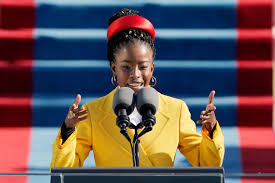
1. Set up your Early Enrichment Mini Spark recording page: #54: Amanda Gorman
2. Read this short article about Ms. Gorman. What was her advice for young poets? Write her advice on your recording sheet.
3. Listen to this poem. Record a line of the poem on your recording sheet.
4. Your challenge is to write a short rhyming poem. The topic is YOU! Use this rhyming dictionary if needed.
5. Share your Early Enrichment Mini Spark recording page with your teacher or EY Coordinator.
2020-21 Weekly Challenge #19: Cold Weather Science Experiments
Below Zero Temperatures = Science Experiments!
For this week’s Weekly Challenge, try one of these Cold Weather Science Experiments and figure out if it’s real or a myth! Don’t forget to share your results!
- Freezing Soap Bubbles: Head outside with some bubble solution and blow some bubbles! NOTE: Try heating up the bubble solution in the microwave beforehand. You can make your own bubble solution with 2 cups of water, half a cup of dish soap, and 2 teaspoons sugar.
- Banana Hammer: Hang a banana outside for a few hours and it will freeze solid-solid enough for you to be able to hammer actual nails with it.
- Make An Ice Thrower: Fill a Super Soaker with boiling water and then shoot it out into the cold. When very hot water meets very cold air, the water vaporizes, turning it into ice crystals…essentially, homemade snow. Don’t have a Super Soaker, just use the pot you boiled the water in.
- Freeze-Fry An Egg: Don’t actually eat it, but leave a frying pan outside for about 15 minutes and then crack an egg into it. What happens?
- Instant Freeze Water – Bottle Slam
If none of these experiments catch your interest, a simple Google search for “Cold Weather Science” will display several options. Have fun and don’t forget to submit your learning!
Submit Your Work Here: https://forms.gle/PcVvit1VbANsZfBcA
2020-21 Weekly Challenge #16: Intro to Opera
Art requires creativity and imagination and enhances flexibility, adaptability, productivity, responsibility and innovation – all required skills for a successful career in any field of study.
The ‘A’ in STEAM represents ‘Art’ which includes music.
source: https://sproutsupplies.com/blog/steam-the-importance-of-art-in-stem-education/
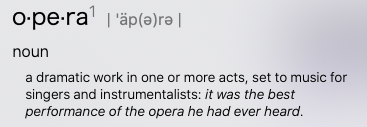
For this week’s Weekly Challenge, you’ll have an opportunity to explore the world of opera. There are several different learning choices. Pick as many activities as you’d like and then demonstrate your learning by creating a product.
- Opera Facts for Kids: https://kids.kiddle.co/Opera
- Kids Meet an Opera Singer: https://youtu.be/95RLviccrQc
- Shh! We Have A Plan | Opera for Kids: https://youtu.be/2k_yEBBEvyw
- Blob Opera: https://artsandculture.google.com/experiment/blob-opera/AAHWrq360NcGbw
- Children’s Opera “Little Red Riding Hood”: https://youtu.be/KdnOZwrrhUA
You are welcome to find other resources of your own. Have fun!
Submit Your Work Here: https://forms.gle/UmK5n4AXx9V5gpG78
NOTE: There is a Marvelous World of Opera badge available if you’re interested. Get a copy of the recording sheet here: https://sites.google.com/westside66.net/eybadgepage/fine-arts-badges?authuser=0
Storytelling Workshop – January 20
Image Source: http://clipart-library.com/clipart/53061.htm
In this half-day workshop, participants will explore the basics of acting, using the natural tools of voice and body, as well as integrating technology to engage in dynamic storytelling. Students will learn how to develop character through movement, sound, and visual composition. By using creativity, self-assessment, and constructive dialogue, students will discover their own unique theatrical narrative style. Contemporary text, improvisation, and personal writing will challenge each student to reach beyond their limits, in order to honestly and joyfully search for their character and story.
Sign up now! https://forms.gle/dZ8fE8goDk2hWWgx7
# 7: Platypus Study

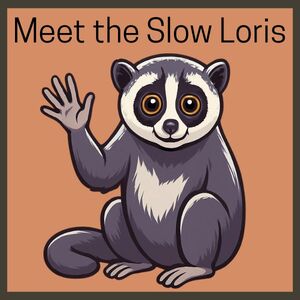
Platypuses continue to uphold their status as one of the most unusual animals on the planet. Recent research published in the scientific journal Mammalia reveals that platypus fur emits a bluish-green glow when exposed to ultraviolet light. Only a handful of other mammals possess this ability, and the platypus is the first monotreme— a type of mammal that lays eggs— to demonstrate this phenomenon.
Spark you thinking!
1. Set up your science mini spark recording page: # 7: Platypus Study
2. Look over this info page and record 5 details on your recording page.
3. Read this article published by Newsela to learn more. Take the quiz after the article, Scroll down carefully as the answers are at the bottom and you don’t want to see them until you are done. Write your answers on your recording page. When you are done, check your work and record your score it on your recording page.
4. Go to this webpage and read more information about the topic. Take 5 notes on your recording page.
5. Choose 1 of these projects
- What other animals have biofluorescence? Do research to find out. Create a list of 5.
- Research scientific sketching. Create a scientific sketch of a platypus. Add a picture to your recording page.
6. Share your science mini spark recording page with your teacher/EY coordinator.
To learn more about another venomous creature check out Science mini spark #41 along with the Nature’s Protection Posion and Venom badge at the EY website.
Weekly Challenge #14 Highlights
And the winner is…
Waylon from Oakdale with a paper tower height of 60 inches!

Check out some of the other awesome structures students built!
Don’t forget to check out the new Weekly Challenge!
2020-21 Weekly Challenge #15: Snowflakes

image source: https://pixabay.com/vectors/flake-snow-snow-flake-snowflake-2029377/
Whether you’re creating one with a folded piece of paper and pair of scissors or you’re learning about the science and math behind them…
Snowflakes are so FASCINATING!
For this week’s Weekly Challenge, you have several different learning choices. Pick as many activities as you’d like and then demonstrate your learning by creating a product.
- Learn about The Science Behind Snow: https://www.noaa.gov/stories/how-do-snowflakes-form-science-behind-snow
- TED-Ed The science of snowflakes – Maruša Bradač: https://youtu.be/FwGH4gulLX4
- The Beauty and Science of Snowflakes: https://ssec.si.edu/stemvisions-blog/beauty-and-science-snowflakes
- Making Paper Snowflakes: https://www.marthastewart.com/266694/decorating-with-paper-snowflakes
- Make a 6-Pointed Paper Snowflake: https://www.instructables.com/How-to-Make-6-Pointed-Paper-Snowflakes/
- The Koch Snowflake: http://gofiguremath.org/fractals/koch-snowflake/
- How to Make Borax Crystal Snowflakes: https://www.livescience.com/41636-borax-crystal-snowflakes.html
Feel free to find other snowflake resources! Learn something new and have fun creating!
Submit Your Work Here: https://forms.gle/xis68jyeLR31efLj7
#55: Bio Poems
 A bio poem is a simple poem that provides biographical information about a person, historical figure, or literary character.
Spark your thinking!
1. Set up your language arts mini spark recording page: #55: Bio Poems
2. A bio poem is a simple poem written about a person, and it follows a predictable pattern. Bio poems generally don’t rhyme, and they can be autobiographical (about yourself) or biographical (about another person). Record this information on your recording sheet.
3. Decide who you want to research for your Bio Poem. Here are some options to get your brainstorming kick started.
- American Presidents
- African American Leaders
- Influential Women
- Favorite Athlete, Musician or Artist
- Family Member or Friend
- Yourself
4. Research your selected person (or interview family member) so that you have content for your Bio Poem. Take notes on your recording page.
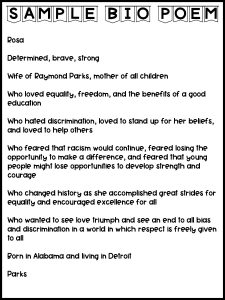
5. Read the sample Bio Poem below about Rosa Parks.
6. Use the guide and template below to draft your own Bio Poem!
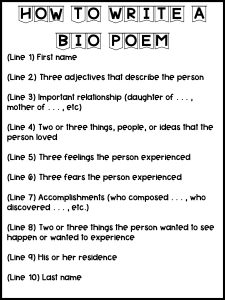
Optional: Draw or include a picture of your selected person.
7. Share your language arts mini spark recording page and your poem with your teacher/EY coordinator.