Category Archives: Learning Opportunities

Social Studies Spark #45: Map for Time Travelers

                                                                          Source: IFL Science

The Internet has a new favorite interactive map system!

ORBIS, the Stanford geospatial network model of the Roman world, allows you to check how long it would take you to travel from location to location during Roman times.

It’s customizable too! In the unlikely event that you were transported back to 200 BCE and yet somehow the 4G network traveled back in time with you, thanks to these maps you’d be able to calculate how long it would take you to get from Londinium to Corinthus by ox, or Augusta Treverorum to Alexandria as part of a military march.

As well as time, the map, which is of course based on historical evidence, shows you how much each journey would cost.

“Conventional maps that represent this world as it appears from space signally fail to capture the severe environmental constraints that governed the flows of people, goods and information,” Stanford wrote at the time of the release of the first version of ORBIS. “Cost, rather than distance, is the principal determinant of connectivity.”

We thought we’d have a look at how long it would take us to get from Londinium to Ierusalem, to ask them a few questions about what made them eventually change the I in their name to a J.

We gave the parameters that we would be traveling by donkey (as well as boat where necessary) and during the winter. According to Google, if we floored it and didn’t need things like sleep, we could arrive by car in 52 hours, or a much nicer 6-8 hours by plane. But, we know that that the journey would take a lot longer in Roman times:

“The Fastest journey from Londinium to Ierusalem in January takes 53.5 days, covering 5,433 kilometers [3,375 miles]. Prices in denarii, based on the use of a faster sail ship and a civilian river boat (where applicable), and on these road options:

Per kilogram of wheat (by donkey): 22.74
Per kilogram of wheat (by wagon): 27.45
Per passenger in a carriage: 1897.51″

If you were to select the cheapest route, it would take you 98.4 days to complete a 6,129-kilometer (3,303-mile) journey. However, you would save yourself nearly 1,000 denarii per passenger, and 7 denarii per kilogram of wheat. And is it really a holiday if you aren’t shipping a wagonload of wheat back with you as a souvenir?

Check out the map for yourself, it’s pretty cool to play with!

In the comments below, let us know what you discovered!

#84 Doodling in Math Class

What?  Did that say DOODLING?  Yes!

Have fun learning about math while doodling from one of my favorite mathematicians/doodlers…Vi Hart!

Spark your math thinking!

  1. Set up your math mini spark recording page: #84 Doodling in Math Class
  2.  Watch both of the Vi Hart videos.
  3. Create a doodle page or ½ page  for each showing what you learned.
  4. Share your math mini spark recording page with your teacher/EY coordinator.


#55: 1-hand book review

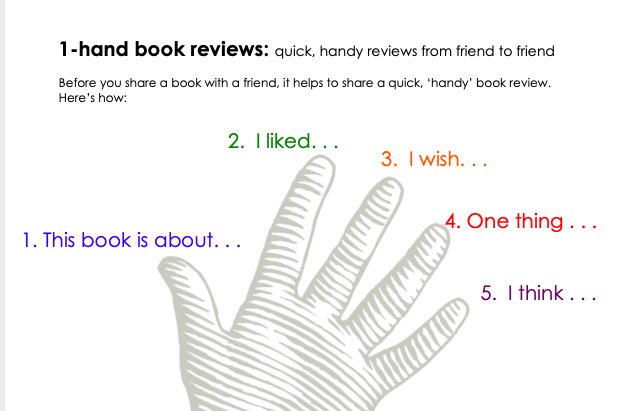
Before you share a book with a friend, it helps to share a quick, ‘handy’ book review. Learn how in this mini spark.

Spark your thinking!

1. Set up your mini spark recording page: #59: 1 hand book review

2. Read over these instructions and write down the 5 sentence starters on your recording page.

3. Choose a book that you have recently read and enjoyed. Write the title on your recording page.

4. Open this sheet and read it. You can print it if you want. You will use this as a guide to writing your own.

5. Create your own script on your recording page.

6. Choose at least two people and read your 1-hand book review to them.

7. Share your early enrichment mini spark recording page with your teacher/EY coordinator.


#59: 1 hand book review

Before you share a book with a friend, it helps to share a quick, ‘handy’ book review. Learn how in this mini spark.

Spark your thinking!

1. Set up your language arts mini spark recording page: #59: 1 hand book review

2. Read over these instructions and write down the 5 sentence starters on your recording page.

3. Choose a book that you have recently read and enjoyed. Write the title on your recording page.

4. Open this sheet and read it. You can print it if you want. You will use this as a guide to writing your own.

5. Create your own script on your recording page.

6. Choose at least two people and read your 1-hand book review to them.

7. Share your language arts mini spark recording page with your teacher/EY coordinator.


#53: STEAM Challenge: Mystery Bag

In this design activity, you will use a bag of mystery materials (an assortment of recyclables and other random items) and then a challenge card stating a building challenge to do with those materials. Then you use those “mystery” materials to complete the challenge.  

Spark your thinking!

1. Set up your STEAM mini spark recording page: #53: STEAM Challenge: Mystery Bag

2.  Print out the free mystery bag challenge cards. Cut them apart.

3. Gather 8-12 different materials. You’ll want to be sure the items are varied. Each bag should contain at least one larger item that can serve as a base for the design, and then an assortment of smaller items.

***Tip: it’s more challenging if a teacher/sibling/or parent fills your bag

  • One bag (you can use gift bags, lunch bags, grocery bags, or even large baggies.)
  • Scissors
  • Tape (scotch tape or masking tape)
  • Various kinds of recyclables (cardboard tubes, cardboard, newspaper, aluminum foil)
  • A variety of other materials (paper plates, plastic cups, string, yarn, pipe cleaners)
  • Mystery Bag Challenge Cards (print and cut these if you can)

4. Pick a challenge card. You could put the cards in a container to draw from or place face down on a table.

5. Record your challenge on your recording page. You could also take a picture of the challenge and add it to your page.

6. Complete the challenge on the card using only the materials in your bag. ***Tip: it’s more challenging if you set a timer for 5 or 10 minutes.

7. Take a picture of your challenge and add it to your recording page.

8. Write one about what was easy about the challenge and one sentence about  what was hard.

9.  Share your STEAM mini spark recording page with your teacher/EY coordinator.

Use this project as your first project mystery bag design challenge badge from the EY website.


#83 The Luhn Algorithm

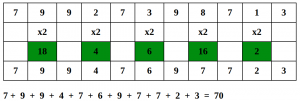
The Luhn algorithm or Luhn formula, also known as the modulus 10″ or “mod 10” algorithm, was developed in the 1960s as a method of validating whether or not identification numbers provided by a user are accurate.
Spark your math thinking!

  1. Set up your math mini spark recording page: #83 The Luhn Algorithm
  2. Look over this chart.   What do you notice about each of the rows?


3. Read this article about the formula and how it is used in real life to catch errors when shopping online.  Choose 2 of these questions to answer with at least two sentences. Remind your teacher that the key can be found in the math mini spark folder.

  1. What is the main purpose of the Luhn Algorithm as described in the text?
  2. How does the algorithm determine if a credit card number is valid after a user inputs it incorrectly? Provide specific steps involved in the process.
  3. What kind of errors might still pass the Luhn Algorithm, even if the sum is a multiple of ten? Explain why these errors can occur.
  4. Why do online stores request additional information, such as the expiration date and card verification number, even if the Luhn Algorithm is used? What does this suggest about the reliability of the algorithm?

3. In this video you will learn how to use the Luhn Algorithm. Make the table on paper as you watch.

4. Optional: Research the creator Peter Luhn and make a timeline with 5-8 details.

5. Optional: Complete the math challenge presented by CEMC math . Print it, read the page and look at the different strategy that they present to you.  Work on the challenge presented.

6. Check your work with this answer key. Remind your teacher that the key can be found in the math mini spark folder.

7. Share your math mini spark recording page with your teacher/EY coordinator.

#58: Halloween Roll-A-Story

Ready for some Halloween writing fun?

Spark your thinking!

1. Set up your language arts mini spark recording page:#58:Halloween Roll-A-Story

2. Grab a die or use this online version

What to do:

  1. Roll your dice three different times.
    1. The first number you roll will be your character. Record it.
    2. The second number you roll will be your setting. Record it.
    3. The third number you roll will be your conflict. Record it.

4. Use your character, setting, and conflict to write a silly spooky story.

5. Optional: Illustrate your story.

6. Share your language arts mini spark recording page and your spooktacular story with your teacher/EY coordinator.

#82: Math in a book

Calling all math detectives!! This is a challenge that combines writing and math.

Spark your math thinking!

  1. Set up your math mini spark recording page: #82: Math in a book
  2. Watch this video and pause it at 34 seconds. Try to figure out the pattern that this poem uses. Hint: It has to do with math. Write down your guess. Continue watching.
  3. When you are done, create your own short poem using the first 10, 15 or 20 numbers as your guide. Write your poem on your recording page.
  4. Share your math mini spark recording page with your teacher/EY coordinator.

#54: Amanda Gorman

Five presidents have had poets read at their Presidential inaugurations. This mini spark is about Amanda Gorman, the youngest inaugural poet in U.S. history!

Spark your thinking!

1.  Set up your Early Enrichment Mini Spark recording page: #54: Amanda Gorman

2.  Read this short article about Ms. Gorman.  What was her advice for young poets? Write her advice on your recording sheet.


3.  Listen to this poem. Record a line of the poem on your recording sheet.

4. Your challenge is to write a short rhyming poem. The topic is YOU!  Use this rhyming dictionary if needed.

5. Share your Early Enrichment Mini Spark recording page with your teacher or EY Coordinator.

#44: Harriet Tubman

Revisit the extraordinary life story of Harriet Tubman – a freedom seeker, conductor on the Underground Railroad, abolitionist, suffragist, and human rights activist. Tubman was born around 1822 Maryland. She is widely celebrated as one of the most respected individuals in American history.

Spark your thinking!

1. Set up your social studies mini spark recording page: #44: Harriet Tubman

2. Read this information about the underground railroad. On your recording page, create a web diagram with a circle in the center and 10 circles around the center. Record “underground railroad” in the center.

3. Read these paragraphs and fill in 5 of the spots with information about the underground railroad. 

4. Watch this TED-ED on the life of Harriet Tubman. Use information from the video to fill out the remaining 5 spots on your web with information about her. 


5. Look at a map, and imagine Harriet, in her 20s, running away, alone, on foot. She managed, with the help of the Underground Railroad, to make it a hundred miles to the Pennsylvania border, and freedom. Bravely, Tubman went back – 13 times over 10 years – leading more than 70 people to freedom.  Why did she risk her life to do this? Respond to this prompt with 3+ sentences. 


6. Choose one prompt and respond with 2-4 sentences. 

Discuss the significance of the Underground Railroad in Harriet Tubman’s life.

What role did Harriet Tubman play during the Civil War, and what was one of her notable achievements?

Describe Harriet Tubman’s involvement in women’s suffrage and her contributions to the cause.

7. Share your social studies mini spark recording page with your teacher/EY coordinator.